

On a busy street near the Duomo in Milan this past April, the usual scenes you’d expect to unfold on a frenetic morning in the city were visible: the yellow trams rumbling by, locals sipping their espressos from zinc counters, well-dressed members of the city’s design and fashion sets whizzing past on bicycles. And if you’d followed one of the latter, you’d very likely have ended up at Palazzo Acerbi, a 17th-century Baroque palace on the Corso di Porto Romano.
Or, more specifically, in its central courtyard, admiring a soaring installation of a gridded wooden sculpture. More curiously, when you looked closer, you would have noticed that they were actually modular chairs, stacked in a cascading wave like a kind of contemporary ziggurat. Heading up the sweeping staircase to the piano nobile, however, the reason for this intervention quickly became clear: it was the grand unveiling of Kelly Wearstler’s first collection with H&M Home.
Down a terrazzo-floored corridor, lamps articulated by stainless steel wires gently glowed beneath a linen-like fabric covering both lampshade and tube, which invited viewers into a series of rooms covered with chintzy floral fabrics, reflected across wonky, funhouse-like mirrors with trompe l’oeil urn-shaped vases crafted from blackened pine. In one room, cloud-like modular bouclé armchairs—which can be paired to form a love seat, or arranged in multiples to make a sofa—were stacked to create a plush mountain stretching two-thirds of the way up the wall, leading the eye up to an elaborately frescoed ceiling.
Throughout the rooms, Kelly Wearstler herself was buzzing
Throughout the rooms, Kelly Wearstler herself was buzzing around in a gray tailored jumpsuit, enthusiastically explaining the details behind every piece—and the cleverly conceived installations that showcased it, created in collaboration with the fashion-favorite design practice Studio Boum. There’s a word that Wearstler kept returning to when describing it all: storytelling.
“We wanted the objects to unfold—and then take hold of—all the different rooms in the house,” she said. While Wearstler is best known for her high-end residential projects and her work in hospitality—notably, in the latter case, for her role as the central design partner for Ian Schrager’s Public Hotels in New York and West Hollywood—she’s tended to be more selective with her collaborations, working on smaller collections in the past with the likes of Farrow & Ball and The Rug Company.
Like many designers working at her level, she found herself frustrated that the price points of what she makes typically remain out of reach for most. “Being able to do something that is accessible to so many people and launching in 40 countries, there was something really cool about that,” she added. “I want to help people to live better, to be creative, and to have really timeless design in their home—design that has a point of view, and that feels unique.”
Wearstler noted that she had long followed H&M’s partnerships with fashion designers—she was a particular fan of their Margiela collaboration back in 2012—and so, when the Swedish retail giant came knocking, it was a quick yes.
She quickly learned the project would come
She quickly learned the project would come with a few constraints, like sizing—if anything, that was all the more liberating. “We have limitations in all of our projects,” she reflected, “but it was great, and it really pushed us to be more creative. It makes you a better designer.”
It’s partly this that led to the modular nature of many of the pieces in the collection—those chairs that were assembled in the palazzo’s courtyard, say, or the bouclé chairs stacked in its historic rooms—and that also helped solidify the core philosophy of the collection: in Wearstler’s words, that these pieces should “be able to reinvent and adapt to your lifestyle.” Other key tenets of that philosophy include thinking about ritual—“reexamining the things you grab every day and you often don’t even think about,” she says—and using mixed materials to lend the pieces “a soul.” Those materials are also, in many cases, surprisingly premium: natural marble, poplar and pine woods, fused glass, wool-cashmere blend throws.
“It’s affordable, but the quality is still there,” Wearstler confirms. “It’s still great design.”
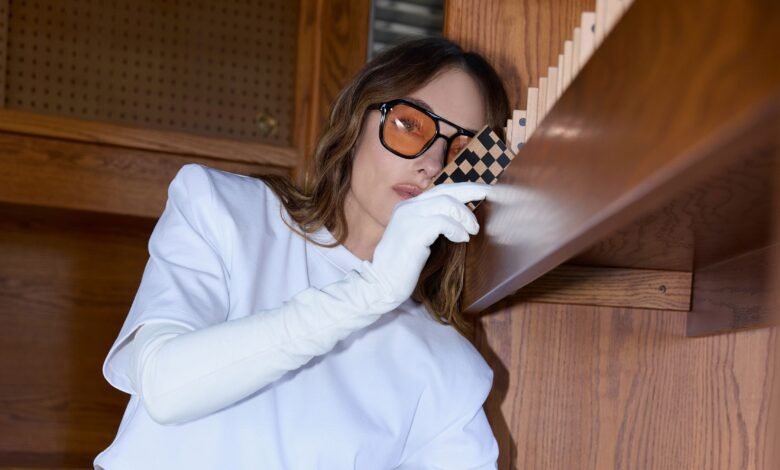
The most surprising element of all, perhaps? The capsule fashion collection that’s debuting alongside it, which came about halfway through the project when Wearstler decided she wanted to make the world she’s creating for H&M as 360-degree as possible. “I said, ‘Would you guys be open to doing that?’” Wearstler recalls.
“Fashion is such a big inspiration for me. Even when we do the hotels, we love to design the uniforms, because it’s a whole lifestyle. How can you leave out fashion? It’s all part of the storytelling.” (There’s that word “storytelling,” again.)
Back in April, Wearstler had already been working on it for 18 months—and now that it’s September, it will have been almost two years since she first put pencil to paper and began sketching out her initial ideas.
How did it feel to see those first
How did it feel to see those first sparks of inspiration made manifest, and to watch people interact with them at Milan Design Week? “It’s like with our hotel projects, when you get to go back and see everyone enjoying it, or getting these amazing DMs or emails saying, ‘I had the most amazing stay, and I noticed this or that.’ Those are so meaningful to me. It’s just so great to see everyone enjoying the pieces.” And now, as of today, truly everyone can enjoy those pieces.
Here, find a selection from Kelly Wearstler’s H&M Home fashion and homewares collection, as curated by Vogue.
Source: www.vogue.com